
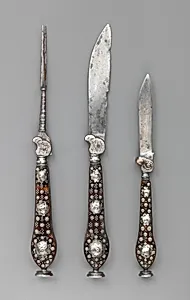
Knife, fork, and pen knife
Unknown Artist
17th century
Medium
Steel, tortoiseshell (or horn), silver
Dimensions
Length (knife, open): 8 in. (20.3 cm); Length (fork): 7 1/8 in. (18.1 cm); Length (pen knife, open): 6 3/8 in. (16.2 cm)
Classification
Metalwork-Steel
Culture
German, Saxony
Department
European Sculpture and Decorative Arts
Museum
Metropolitan Museum of Art, New York, NY
Credit
Gift of R. Stuyvesant, 1893
Accession Number
93.13.51–.53
Rights
Public Domain
Art Historical Context
This exquisite set of a knife, fork, and pen knife hails from 17th-century Saxony,, a region renowned for its masterful metalworking traditions. Crafted as portable personal eating utensils, these items reflect the era's evolving table manners, when forks were gaining popularity among European elites as symbols of refinement and hygiene. No longer just functional tools, they served as status objects, carried by travelers or kept in pockets for daily use. The blades are finely forged from steel, with handles crafted from luxurious tortoiseshell (or horn) and accented with silver, showcasing the intricate techniques of Saxon artisans. Such combinations of materials highlight the decorative arts' emphasis on contrasting textures and gleaming metals, often involving precise inlay work or mounts. Measuring about 6 to 8 inches when open, their compact size underscores their practicality for personal carry. Now housed in the Metropolitan Museum of Art's Department of European Sculpture and Decorative Arts—thanks to a 1893 gift from R. Stuyvesant—this rare ensemble offers a tangible glimpse into Baroque-era craftsmanship and daily luxury, reminding us how everyday objects embodied artistry and cultural prestige.