
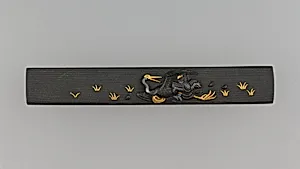
Knife Handle (Kozuka)
Unknown Artist
1816–56
Medium
Copper-gold alloy (shakudō), gold, silver
Dimensions
L. 3 13/16 in. (9.7 cm); W. 9/16 in. (1.4 cm); thickness 5/16 in. (0.8 cm); Wt. 1.2 oz. (34 g)
Classification
Sword Furniture-Kozuka
Culture
Japanese
Department
Arms and Armor
Museum
Metropolitan Museum of Art, New York, NY
Credit
Gift of Herman A. E. and Paul C. Jaehne, 1943
Accession Number
43.120.122
Rights
Public Domain
Tags
Art Historical Context
This exquisite **Knife Handle (Koz)**, crafted in Japan between 1816 1856 during the late Edo period, served as a functional yet artistic component of a samurai's sword ensemble. The kozuka was the handle for a small utility knife tucked into the scabbard alongside main blade, embodying the samurai's blend of practicality and refined aesthetics. Produced in an era when Japan's isolationist policies fostered a flourishing of decorative metalwork, this piece reflects the height of tosogu—sword fittings—that transformed weapons into wearable art. Fashioned from shakudō, a copper-gold alloy patinated to a subtle dark sheen, the handle is enriched with inlays of gold and silver, likely depicting graceful cranes—a motif symbolizing longevity, good fortune, and fidelity in Japanese culture. At just under 4 inches long and weighing a mere 1.2 ounces, its compact form highlights the artisan's mastery of precision techniques like zōgan (metal inlay), where softer metals are hammered into carved channels for vivid contrast. Housed in the Metropolitan Museum of Art's Arms and Armor Department, this gift from Herman A. E. and Paul C. Jaehne in 1943 offers a window into Japan's warrior heritage. Far from mere weaponry, such objects celebrated impermanence and beauty, reminding us how everyday tools could carry profound cultural poetry.