
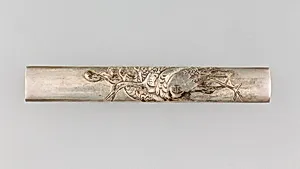
Knife Handle (Kozuka)
Unknown Artist
18th century
Medium
Silver
Dimensions
L. 3 13/16 in. (9.7 cm); W. 9/16 in. (1.4 cm); thickness 3/16 in. (0.5 cm); Wt. 1.2 oz. (34 g)
Classification
Sword Furniture-Kozuka
Culture
Japanese
Department
Arms and Armor
Museum
Metropolitan Museum of Art, New York, NY
Credit
The Howard Mansfield Collection, Gift of Howard Mansfield, 1936
Accession Number
36.120.342
Rights
Public Domain
Tags
Art Historical Context
This exquisite silver *kozuka*, or knife handle, from 18th-century Japan, exemplifies the masterful fusion of function and artistry in samurai sword fittings. During the Edo period (1603–1868), a time of relative peace, warriors turned their skills toward elaborate decoration for weapons, transforming practical items like the *kozuka*—a small utility knife into the sword scabbard—into coveted works of art. Measuring just under 4 inches long, handle would have complemented a katana or wakizashi, showcasing the wearer's refined taste. Crafted from silver, the medium allowed for intricate techniques such as chasing, repoussé, or engraving, lending a luminous sheen that highlighted motifs like birds, as suggested by its design. Birds often symbolized freedom, longevity, or seasonal beauty in Japanese aesthetics, drawing from nature-inspired traditions in metalwork. The precise dimensions and lightweight construction (1.2 oz.) reflect expert craftsmanship, balancing durability for combat utility with delicate ornamental appeal. Housed in the Metropolitan Museum of Art's Arms and Armor Department, this piece entered the collection in 1936 as part of The Howard Mansfield Collection. It invites visitors to appreciate how Japanese artisans elevated everyday arms into symbols of cultural sophistication, bridging the worlds of war and poetry.