
Knife Handle (Kozuka)
Unknown Artist
mid-19th century
Medium
Copper-silver alloy (shibuichi), gold, silver, copper-gold alloy (shakudō), copper
Dimensions
L. 3 13/16 in. (9.7 cm); W. 9/16 in. (1.4 cm); thickness 3/16 in. (0.5 cm); Wt. 1.1 oz. (31.2 g)
Classification
Sword Furniture-Kozuka
Culture
Japanese
Department
Arms and Armor
Museum
Metropolitan Museum of Art, New York, NY
Credit
The Howard Mansfield Collection, Gift of Howard Mansfield, 1936
Accession Number
36.120.261
Rights
Public Domain
Tags
Art Historical Context
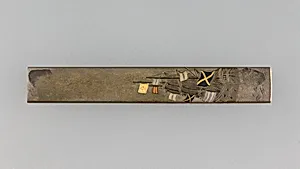
This exquisite *Knife Handle (Kozuka)* from mid-19th-century Japan is a masterful example of sword furniture, designed as the hilt for a small utility knife carried alongside a samurai's katana or wakizashi. Crafted during the late Edo period, when Japan balanced traditional warrior culture with emerging modernization, these fittings transformed weapons into wearable art. The handle's surface likely features intricate depictions of ships—evoking maritime prowess and the era's seafaring motifs—highlighting the artisan's skill in capturing dynamic scenes on a compact scale. Forged from a luxurious mix of metals—shibuichi (a copper-silver alloy prized for its subtle patina), shakudō (copper-gold alloy with a dark sheen), gold, silver, and copper—the kozuka showcases advanced Japanese metalworking techniques like zōgan inlay and nuanced patination. At just 3 13/16 inches long and weighing a mere 1.1 ounces, its delicate proportions belie the precision required, making it both functional and ornamental. Housed in the Metropolitan Museum of Art's Arms and Armor Department as part of the Howard Mansfield Collection (gifted in 1936), this piece reflects the refined aesthetic of samurai accoutrements, where beauty elevated everyday tools into symbols of status and artistry. Visitors will appreciate how it bridges utility and elegance in Japan's storied martial heritage.