
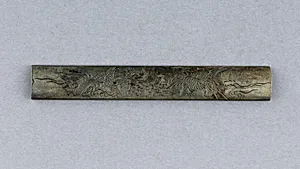
Knife Handle (Kozuka)
Unknown Artist
end of 18th century
Medium
Silver
Dimensions
L. 3 7/8 in. (9.8 cm); W. 9/16 in. (1.4 cm); thickness 3/16 in. (0.5 cm); Wt. 1.1 oz. (31.2 g)
Classification
Sword Furniture-Kozuka
Culture
Japanese
Department
Arms and Armor
Museum
Metropolitan Museum of Art, New York, NY
Credit
The Friedsam Collection, Bequest of Michael Friedsam, 1931
Accession Number
32.100.468
Rights
Public Domain
Tags
Art Historical Context
This exquisite silver kozuka, or knife handle, hails from late 18th-century Japan during the Edo period, a when samurai culture emphasized refined artistry over battlefield utility. Measuring just under 4 inches long, this slender piece (L. 3 7/8 in.) was designed to fit seamlessly into the scabbard of a katana or wakizashi sword, housing a small utility knife used for everyday tasks like cutting or self-defense. Crafted in gleaming silver, it exemplifies the masterful metalworking techniques of Japanese sword fittings, where artisans employed chasing, engraving, and possibly inlay to create intricate designs—here, featuring bird motifs that evoke the natural world so revered in Japanese aesthetics. Birds on such objects often symbolized grace, freedom, or seasonal change, reflecting Zen-inspired harmony between humanity and nature. Though the artist remains unknown, the kozuka's precision and elegance highlight the guild traditions of Edo metalworkers, who transformed functional arms into wearable sculptures. Part of the Metropolitan Museum of Art's Arms and Armor collection, gifted through The Friedsam Collection in 1931, it offers a window into Japan's opulent material culture, where even a hidden knife handle became a canvas for poetic expression.