
Knife Handle (Kozuka)
Unknown Artist
18th century
Medium
Silver, copper-gold alloy (shakudō), gold
Dimensions
L. 3 13/16 in. (9.7 cm); W. 9/16 in. (1.4 cm); thickness 1/4 in. (0.6 cm); Wt. 1.3 oz. (36.9 g)
Classification
Sword Furniture-Kozuka
Culture
Japanese
Department
Arms and Armor
Museum
Metropolitan Museum of Art, New York, NY
Credit
Gift of Bashford Dean, 1919
Accession Number
19.59.1
Rights
Public Domain
Tags
Art Historical Context
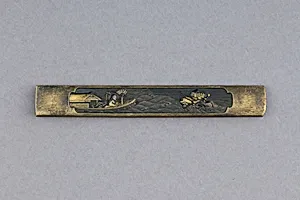
This exquisite 18th-century Japanesekozuka*, or knife handle, is a masterful example of Edo-period sword furniture, designed to sheath a small utility knife alongside a samurai's katana.ed during a time of relative peace when martial arts blended seamlessly with artistic refinement, such fittings transformed functional weapons into wearable sculptures. Measuring just under 4 inches long, this lightweight piece (1.3 oz.) would have been tucked into the scabbard, showcasing the owner's taste and status. The handle gleams with silver, shakudō—a copper-gold alloy patinated to a rich black hue—and intricate gold inlays. Japanese metalworkers excelled in these mixed-metal techniques, known as *zōgan* or *hira-zōgan*, where gold and silver threads depict dynamic scenes. Here, lively motifs of human figures, boats, and horses evoke tales of travel, adventure, or daily life, rendered with fluid precision that captures motion and narrative depth. These decorations highlight the era's fascination with nature, journey, and human endeavor. A gift to the Metropolitan Museum of Art from Bashford Dean in 1919, this *kozuka* embodies Japan's tradition of elevating everyday objects to art, reminding us how samurai culture prized beauty as much as utility. Visitors, imagine slipping this into your own scabbard—art you could carry into battle or peace.