
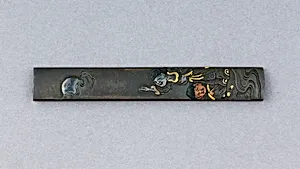
Knife Handle (Kozuka)
Unknown Artist
ca. 1615–1868
Medium
Copper-silver alloy (shibuichi), copper-gold alloy (shakudō), gold, silver, copper
Dimensions
L. 3 13/16 in. (9.7 cm); W. 9/16 in. (1.4 cm); thickness 3/16 in. (0.5 cm); Wt. 1.2 oz. (34 g)
Classification
Sword Furniture-Kozuka
Culture
Japanese
Department
Arms and Armor
Museum
Metropolitan Museum of Art, New York, NY
Credit
H. O. Havemeyer Collection, Bequest of Mrs. H. O. Havemeyer, 1929
Accession Number
29.100.1165
Rights
Public Domain
Tags
Art Historical Context
This exquisite *Knife Handle (Kozuka)* hails from Japan during the Edo period (. 1615–1868), a time of peace when samurai culture emphasized artistry over warfare. As part of a sword's fittings, the kozuka served as the handle for a small utility knife tucked into the scabbard alongside the tanto blade. Crafted for both function and display, it reflects the refined metalworking traditions of Japanese arms and armor, where even everyday tools became canvases for beauty. Forged from shibuichi—a copper-silver alloy with a subtle patina—and shakudō, a copper-gold blend prized for its deep blue-black tone, the handle is enriched with gold, silver, and copper accents. These materials, hallmarks of the *kinko* (metalworking) school, allowed artisans to create intricate designs, likely featuring human figures as suggested by its motifs. At just 3 13/16 inches long and weighing a mere 1.2 ounces, its compact form highlights the precision of Japanese craftsmanship. Now in the Metropolitan Museum of Art's H. O. Havemeyer Collection, this piece invites us to appreciate the fusion of utility and elegance in Edo-era Japan, where weapons were as much art as armament.