
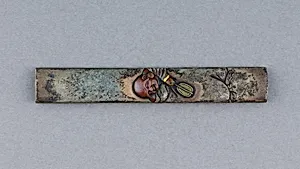
Knife Handle (Kozuka)
Unknown Artist
ca. 1615–1868
Medium
Silver, copper, gold
Dimensions
L. 3 13/16 in. (9.7 cm); W. 9/16 in. (1.4 cm); thickness 1/4 in. (0.6 cm); Wt. 1.1 oz. (31.2 g)
Classification
Sword Furniture-Kozuka
Culture
Japanese
Department
Arms and Armor
Museum
Metropolitan Museum of Art, New York, NY
Credit
H. O. Havemeyer Collection, Bequest of Mrs. H. O. Havemeyer, 1929
Accession Number
29.100.1241
Rights
Public Domain
Tags
Art Historical Context
This exquisite *Knife Handle (Kozuka)* hails from Japan during the Edo period (. 1615–1868), a time of relative peace under the Tokugawa shogunate when samurai culture reached its artistic zenith. As part of a samurai's sword ensemble, the kozuka served as the handle for a small utility knife tucked into the scabbard alongside main blade. Though the artist remains unknown, such fittings were prized status symbols, transforming functional weapons into wearable art. Crafted from silver, copper, and gold, this compact piece (just under 4 inches long) showcases the masterful metalworking techniques of Japanese artisans. Gold and silver were often inlaid or damascened onto a copper base, creating shimmering contrasts that highlighted motifs—here possibly evoking masculine themes, as suggested by its tagging. These intricate designs demanded exceptional skill, blending practicality with opulence. Housed in the Metropolitan Museum of Art's Arms and Armor Department, this kozuka entered the collection via the H. O. Havemeyer bequest in 1929. It offers a window into the refined aesthetics of feudal Japan, where even a knife handle embodied the warrior's elegance and the era's metallurgical prowess.