
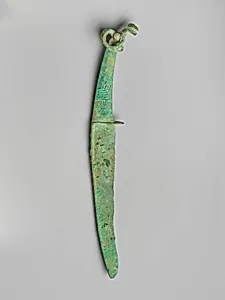
商青銅羊首刀|Knife with Ram's Head
Unknown Artist
12th–11th century BCE
Medium
Bronze inlaid with turquoise
Dimensions
L. 10 5/8 in. (27 cm)
Classification
Metalwork
Culture & Period
China · Shang dynasty (ca. 1600–1046 B.C.)
Department
Asian Art
Museum
Metropolitan Museum of Art, New York, NY
Credit
Gift of Mrs. John Marriott, Mrs. John Barry Ryan, Gilbert W. Kahn, and Roger Wolfe Kahn (children of Addie W. Kahn), 1949
Accession Number
49.136.9
Rights
Public Domain
Art Historical Context
Step into the world of ancient China with this exquisite *Knife with Ram's Head from the Shang dynasty (. 1600–1046 BCE), crafted in the 12th–11th BCE by an unknown artist. Measuring just 10⅝ inches (27 cm) long, this bronze blade features a striking ram's head handle, with vibrant turquoise inlays that catch the light and evoke the sophistication of elite craftsmanship. Housed in the Metropolitan Museum of Art's Art Department, it was generously gifted in 1949 the children of Addie W. Kahn. The Shang dynasty marked a pinnacle of Bronze Age metallurgy in China, where artisans mastered piece-mold casting to produce ritual objects, weapons, and tools symbolizing power and prestige. This knife, classified as metalwork, exemplifies that ingenuity: the turquoise inlay—a rare and labor-intensive technique—involved cutting channels into the bronze and setting semiprecious stones, reserved for high-status items likely used in ceremonies or burials. Animal motifs like the ram's head carried spiritual significance, linking the physical world to ancestral forces. Though small, this artifact reveals the Shang elite's reverence for artistry and ritual, bridging daily utility with the divine. Imagine it in a royal tomb, gleaming amid offerings—a testament to a civilization's enduring legacy.