
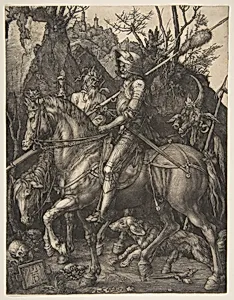
Knight, Death, and the Devil
1513
Medium
Engraving
Dimensions
sheet: 9 9/16 x 7 3/8 in. (24.3 x 18.8 cm)
Classification
Prints
Department
Drawings and Prints
Museum
Metropolitan Museum of Art, New York, NY
Credit
Gift of Estate of Rosina H. Hoppin, 1965
Accession Number
65.690.1
Rights
Public Domain
Tags
Art Historical Context
Albrecht Dürer's *Knight, Death, and Devil* (1513) is a masterful engraving from Northern Renaissance, capturing a dramatic confrontation between steadfast faith and existential threats. The image depicts a armored knight riding resolutely forward on horseback, accompanied by a loyal dog, while skeletal Death and a horned devil lurk menacingly behind. Created at the height of Dürer's, this print draws from humanist ideals and Christian morality, possibly inspired by Erasmus's *Enchiridion militis Christiani*, portraying the knight as a metaphor for the virtuous soul enduring temptation and mortality. Dürer's engraving technique shines here: using intricate copperplate lines, he achieves astonishing depth, texture, and movement on a modest sheet (9 9/16 x 7 3/8 in.). Shadows on the horse's muscles and the rocky landscape create a sense of perilous motion, showcasing his revolutionary precision that made prints accessible and collectible across Europe. One of Dürer's three "Meisterstiche" (master engravings), this work at the Metropolitan Museum of Art—gifted in 1965—remains a cultural icon of resilience, blending Gothic detail with emerging Renaissance realism to inspire viewers for centuries.
About the Artist
Albrecht Dürer · 1471–1528
Albrecht Dürer (1471–1528) stands as the preeminent figure of the Northern Renaissance and arguably the most influential artist in the history of printmaking. Born in Nuremberg on May 21, 1471, and dying in the same city on April 6, 1528, Dürer revolutionized the status of the artist in Northern Europe, transforming printmaking from a commercial craft into an independent fine art and establishing ...