
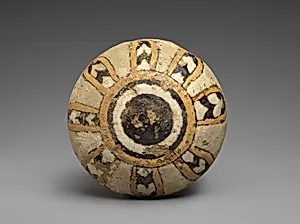
Knob with an eight-petaled rosette
Unknown Artist
ca. 883–859 BCE
Medium
Ceramic, paint
Dimensions
3 3/4 × 3 3/4 × 3 7/16 in. (9.6 × 9.6 × 8.8 cm)
Classification
Ceramics-Implements
Culture & Period
Assyrian · Neo-Assyrian
Department
Ancient Near Eastern Art
Museum
Metropolitan Museum of Art, New York, NY
Credit
Rogers Fund, 1958
Accession Number
58.31.29
Rights
Public Domain
Art Historical Context
This charming ceramic knob, dating to around 883–859 BCE, hails from the Neo-Assrian period in ancient Mesopotamia. Crafted by an unknown artist, it exemplifies everyday artistry from the height of the Assyrian Empire, time of military prowess and cultural flourishing centered in cities like Nimrud and Nineveh. Measuring just under 4 inches across, this small implement—likely used on furniture, doors, or vessels—invites us to glimpse the refined details of domestic life amid imperial grandeur. The knob's eight-petaled rosette motif, painted on fired ceramic, reflects a hallmark of Assyrian decorative aesthetics. Rosettes, evoking stylized flowers or celestial symbols, appear frequently in palace reliefs and seals, suggesting protective or auspicious meanings. The use of ceramic with pigment highlights practical innovation: durable clay was molded and painted for both function and beauty, making ornate designs accessible beyond elite metals or stone. On view in the Metropolitan Museum of Art's Ancient Near Eastern Art department (acquired via the Rogers Fund in 1958), this artifact bridges the monumental and the mundane, reminding visitors of the Assyrians' mastery in infusing symbolism into the ordinary. A testament to enduring craftsmanship, it whispers stories of a world where even a simple knob bloomed with cosmic elegance.