
Kris
Unknown Artist
16th–19th century
Medium
Steel, wood
Dimensions
L. 14 in. (35.6 cm); L. of blade 11 in. (27.9 cm); W. 2 3/4 in. (7 cm); Wt. 2.8 oz. (79.4 g)
Classification
Krisses
Culture
Javanese
Department
Arms and Armor
Museum
Metropolitan Museum of Art, New York, NY
Credit
Bequest of George C. Stone, 1935
Accession Number
36.25.1127
Rights
Public Domain
Art Historical Context
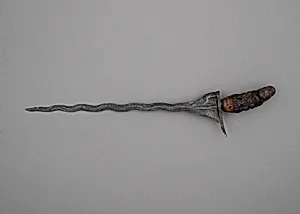
This exquisite Javanese *kris*, dating from the 16th to 19th century, exemplifies revered daggers central to Indonesian culture, particularly on the island of Java. Classified among the museum's collection of krisses in the Arms and Armor department it served not only as a weapon but also as a potent symbol of status, masculinity, and spiritual power. Wielded by warriors, nobles, and even spiritual figures, the kris embodied mystical beliefs—its blade thought to house a soul or protective spirit, influencing its intricate craftsmanship and ritual use. Crafted from steel and wood, this lightweight example (just 2.8 oz. or 79.4 g) measures 14 inches overall, with an 11-inch blade that's characteristically wavy and asymmetrical, a hallmark of Javanese metallurgy. Artisans employed advanced forging techniques, often creating pamor patterns in the steel through layered welding, which enhanced both beauty and lethality while warding off evil. The wooden hilt, ergonomically shaped for grip, was frequently embellished with symbolic carvings evoking serpents or mythical motifs. Acquired through the 1935 bequest of George C. Stone to the Metropolitan Museum of Art, this kris offers visitors a tangible link to Java's vibrant martial and ceremonial traditions, bridging centuries of history in a deceptively delicate form.