
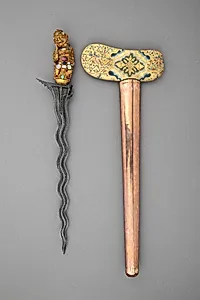
Kris with Sheath
Unknown Artist
19th century
Medium
Steel, wood, copper, gold, semiprecious stones, turquoise, pigment
Dimensions
L. with sheath 23 3/4 in. (60.3 cm); L. without sheath 18 3/4 in. (47.6 cm); W. 3 in. (7.6 cm); Wt. 12.2 oz. (345.9 g); Wt. of sheath 11.4 oz. (323.2 g)
Classification
Krisses
Culture
Balinese
Department
Arms and Armor
Museum
Metropolitan Museum of Art, New York, NY
Credit
The Collection of Giovanni P. Morosini, presented by his daughter Giulia, 1932
Accession Number
32.75.255a, b
Rights
Public Domain
Art Historical Context
This exquisite Balinese *kris* with sheath, dating to the 19th century, exemplifies the masterful fusion of functionality and artistry in Southeast Asian arms. The *kris*, a distinctive wavy-bladed dagger, held profound cultural importance in Bali, where it served not only as a weapon but also as a spiritualisman and status symbol. Wielded by warriors, nobles, and priests, these daggers were believed to possess mystical powers, their serpentine blades symbolizing the naga (dragon) and cosmic energy central to Balinese Hinduism. Crafted from steel for the blade, with a wooden hilt and sheath adorned in copper, gold, semiprecious stones, turquoise, and pigment, this piece showcases exceptional metallurgical skill and decorative opulence. The undulating blade, measuring 18¾ inches without sheath, was forged using pamor techniques—layering metals for hypnotic watery patterns thought to enhance potency. The lavish scabbard, weighing nearly as much as the blade itself, reflects Bali's renowned goldwork and gem-setting traditions, reserved for elite patrons. Generously donated to the Metropolitan Museum of Art in 1932 from Giovanni P. Morosini's collection, this *kris* invites visitors to appreciate Bali's rich legacy of blending the martial, the sacred, and the sublime in everyday objects.