
Kris with Sheath
Unknown Artist
16th–19th century
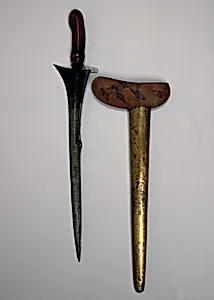
Medium
Kajoe pelet, brass
Dimensions
L. with sheath 17 1/2 in. (44.5 cm); L. without sheath 16 1/2 in. (41.9 cm); L. of blade 13 in. (33 cm); W. 3 1/2 in. (8.9 cm); Wt. 6.9 oz. (195.6 g); Wt. of sheath 3.7 oz. (104.9 g)
Classification
Krisses
Culture
Javanese
Department
Arms and Armor
Museum
Metropolitan Museum of Art, New York, NY
Credit
Bequest of George C. Stone, 1935
Accession Number
36.25.1229a, b
Rights
Public Domain
Art Historical Context
This exquisite *Kris with Sheath a masterpiece of Javanese craftsmanship from the 16th to 19th century, exemplifies the wavy-bladed dagger revered across Southeast Asia. Housed in the Metropolitan Museum of Art's Arms Armor Department as part of the bequest of George C. Stone in 1935, this measures 17½ inches with its sheath and weighs just under 11 ounces total. Crafted with a hilt of *kajoe pelet*—a spiritually significant Javanese wood—and brass fittings, it reflects the fusion of utility and mysticism in traditional Javanese culture. The kris, or *keris*, was far more than a weapon; it symbolized power, status, and supernatural protection for warriors, nobility, and spiritual leaders. Its sinuous blade, here 13 inches long, was believed to hold magical properties, with undulating patterns thought to channel energy or ward off evil. Javanese smiths employed intricate forging techniques, often incorporating meteoritic iron for a pamor (damascene) effect, blending functionality with artistry. Today, this kris invites us to appreciate Java's rich heritage, where arms were also talismans. Marvel at its balance and detail—perfect for both battle and ceremony—in the Met's renowned collection of krisses.