
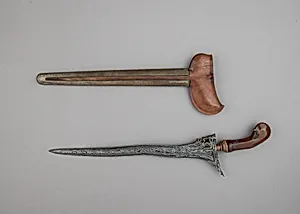
Kris with Sheath
Unknown Artist
16th–19th century
Medium
Steel, wood, copper, gold
Dimensions
L. with sheath 20 in. (50.8 cm); L. without sheath 19 1/4 in. (48.9 cm); L. of blade 14 3/4 in. (37.4 cm); W. 4 3/8 in. (11.1 cm); Wt. 14.9 oz. (422.4 g); Wt. of sheath 6.1 oz. (172.9 g)
Classification
Krisses
Culture
Javanese
Department
Arms and Armor
Museum
Metropolitan Museum of Art, New York, NY
Credit
Bequest of George C. Stone, 1935
Accession Number
36.25.1136a, b
Rights
Public Domain
Art Historical Context
This exquisite Javanese *kris with sheath*, dating from the 16th to 19th century, exemplifies masterful arms and armor traditions of Java, Indonesia. The *kris*—a distinctive asymmetrical dagger classified among Southeast Asia's most iconic edged weapons—features a slender steel blade measuring 14¾ inches long, housed in a matching sheath of wood inlaid with copper and gold With an overall length of 20 inches and a weight of just under a pound, its balanced design made it both a practical tool for combat and a symbol of prestige. Crafted by an unknown artisan, the *kris* showcases sophisticated metallurgy and decorative techniques, blending functional steel forging with opulent materials like gold for sheaths reserved for nobility. In Javanese culture, these daggers transcended mere weaponry; their undulating blades and ornate hilts often held spiritual significance, believed to embody supernatural powers or ancestral spirits, and were essential accessories for warriors, rulers, and ceremonial dress. Now part of the Metropolitan Museum of Art's Arms and Armor collection, thanks to the 1935 bequest of George C. Stone, this piece invites us to appreciate Java's rich fusion of artistry, utility, and mysticism during centuries of Islamic sultanates and colonial encounters.