
Kruisiging
1608 - 1635
Medium
engraving
Dimensions
104; 149
Rights
Public Domain
About this artwork
gravure
Art Historical Context
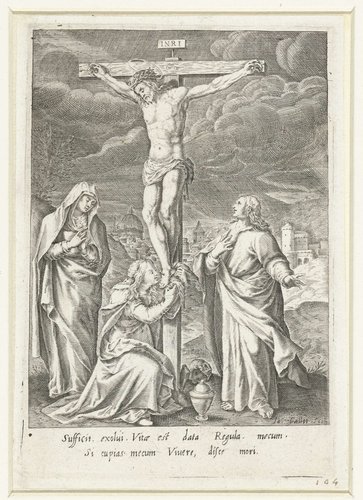
Jacques Callot's *Kruisiging* (Crucifixion), exquisite engraving from his prolific career spanning 16081635, captures one of Christianity's most poignant moments. Measuring just 149 × 104 mm, this print exemplifies Callot's mastery as a leading French Baroque printmaker. Born in Nancy, France, Callot trained in Italy and became renowned for his intricate etchings and engravings, blending Mannerist elegance with emerging Baroque drama. Religious subjects like this were central to his oeuvre, reflecting the Counter-Reformation's emphasis on emotional devotion. Created through the meticulous engraving technique—incising fine lines into a copper plate with a burin—*Kruisiging* showcases Callot's signature style: densely packed compositions with astonishing detail. His ability to render textures, expressions, and crowded scenes in miniature scale made his prints highly sought after, influencing generations of artists from Rembrandt to Goya. This work likely draws from traditional iconography, depicting Christ on the cross amid mourning figures, evoking profound pathos. As a "gravure" or intaglio print, it highlights the era's revolutionary printmaking, allowing wide dissemination of sacred imagery to the faithful. Visitors will appreciate how Callot's technical virtuosity turns a small sheet into a window on 17th-century spirituality and artistry.
About the Artist
Jacques Callot · 1592–1635
Jacques Callot (1592–1635) was a French printmaker and draftsman from the Duchy of Lorraine, widely regarded as one of the first great artists to practice the graphic arts exclusively. His more than 1,400 etchings chronicled the breadth of 17th-century life, from Medici court festivities to the brutal realities of warfare. Callot revolutionized etching through technical innovations including the é...