
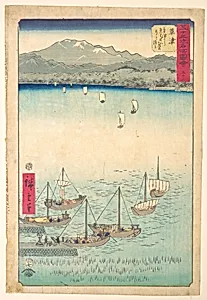
五十三次名所図会 草津|Kusatsu
Medium
Woodblock print; ink and color on paper
Dimensions
H. 14 1/2 in. (36.8 cm); W. 9 3/4 in. (24.8 cm)
Classification
Prints
Culture & Period
Japan · Edo period (1615–1868)
Department
Asian Art
Museum
Metropolitan Museum of Art, New York, NY
Credit
Gift of Mrs. Henry J. Bernheim, 1945
Accession Number
JP1476
Rights
Public Domain
Tags
Art Historical Context
Utagawa Hiroshige (1797–1858), a master of Japanese ukiyo-e woodblock prints, created *Kusatsu* in 1855 as part of his series *The Famous Places of the Fifty-three Stations of the Tōkaidō*. This iconic route connected Edo (modern Tokyo) to Kyoto, serving as a vital highway during the Edo period (1615–1868). Hiroshige's works romanticized these post stations, capturing travelers' experiences amid stunning landscapes and blending everyday life with poetic beauty. In this print, the view of Kusatsu—station 52 near Lake Biwa—evokes serenity with towering mountains, shimmering waters, and boats gliding across the scene. Hiroshige's genius lies in his atmospheric perspective, using subtle gradations of color to suggest depth and mist, hallmarks of his landscape style that influenced Western artists like Van Gogh and Monet. Produced via intricate woodblock printing with ink and color on paper (14½ × 9¾ in.), these affordable prints democratized art in 19th-century Japan, reflecting a cultural fascination with travel and nature. Gifted to the Metropolitan Museum of Art in 1945, *Kusatsu* exemplifies Hiroshige's enduring legacy in celebrating Japan's ephemeral beauty.
About the Artist
Utagawa Hiroshige · 1826–1869
Utagawa Hiroshige (1797–1858), born Andō Tokutarō, was the last great master of Japanese ukiyo-e woodblock printmaking and one of the most influential landscape artists in history. Born in Edo (modern Tokyo) into a low-ranking samurai family serving as fire wardens, Hiroshige transformed landscape printmaking into a poetic meditation on nature, weather, and everyday life. His revolutionary approac...