
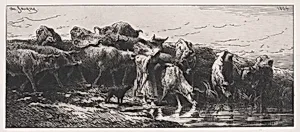
L'Abreuvoir
1866
Medium
Drypoint
Dimensions
Plate: 6 5/16 × 12 3/8 in. (16 × 31.5 cm) Image: 4 11/16 in. × 11 in. (11.9 × 27.9 cm)
Classification
Prints
Department
Drawings and Prints
Museum
Metropolitan Museum of Art, New York, NY
Credit
Harris Brisbane Dick Fund, 1927
Accession Number
27.10.65
Rights
Public Domain
Tags
Art Historical Context
**L'Abreuvoir (The Watering Place), 1866** Charles Jacque, a prominent French artist of the Barbizon school, captures the serene rhythm of rural life in *L'Abreuvoir*. This drypoint print likely depicts cows gathered at a watering trough, evoking the pastoral landscapes Jacque cherished. Active in the mid-19th century, was renowned for his animalier subjectsep, cattle, and barnyard scenes—rendered with a keen eye for nature's quiet drama. Acquired through the Harris Brisbane Dick Fund in1927, this work now graces the Metropolitan Museum of Art's Drawings and Prints department, highlighting Jacque's mastery in translating everyday countryside moments into art. Drypoint, Jacque's chosen medium here, is an intimate intaglio technique where a sharp tool scratches directly into a metal plate, raising a soft burr that yields richly textured, velvety lines. Unlike etched plates, drypoints produce fewer impressions before the burr flattens, making each print uniquely expressive and collectible. The modest plate size (6 5/16 × 12 3/8 in.) invites close viewing, revealing the artist's fluid strokes that mimic fur and foliage with remarkable tactility. In an era of rapid industrialization, Jacque's print offered a nostalgic escape to France's countryside, bridging Realism's truthful observation with the Barbizon painters' love for unidealized nature. A gem for print enthusiasts, it celebrates the humble beauty of farm life. (198 words)
About the Artist
Charles Jacque · 1813–1894
Charles-Émile Jacque (1813–1894) was a pioneering French painter, engraver, and illustrator whose career bridged the worlds of printmaking and pastoral painting. Born in Paris amid a difficult childhood, he apprenticed at age seventeen to a map engraver, mastering drypoint technique and producing his first etching in 1830—a copy of a head after Rembrandt. After serving seven years in the French Ar...