
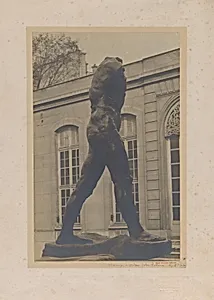
L'Homme Qui Marche
1907–12
Medium
Gelatin silver print
Dimensions
36.2 x 23.2 cm. (14 1/4 x 9 1/8 in.)
Classification
Photographs
Department
Photographs
Museum
Metropolitan Museum of Art, New York, NY
Credit
Gift of Miss G. Louise Robinson, 1940, transferred from the Library
Accession Number
1988.1173
Rights
Public Domain
Tags
Art Historical Context
Step into the dynamic world of early 20th-century Parisian art with *L'Homme Qui Marche* (The Man Who Walks), captivating gelatin silver print by Eugène Druet, created between 1907 and1912. This 36.2 x 23.2 cm photograph captures a striding male figure in sculpture, embodying the era's fascination with movement and the human form. Druet a pioneering photographer and art dealer, specialized in documenting the bold works of contemporaries like Aristide Maillol and Antoine Bourdelle, preserving their innovative visions for posterity. Gelatin silver prints, popular from the 1880s onward, revolutionized photography with their rich tonal range and sharp detail, allowing Druet to highlight the sculpture's muscular tension and forward momentum. This medium's matte surface and subtle gradations draw viewers into the three-dimensional energy of the original work, bridging photography and sculpture in a time when modernism was emerging. Housed in the Metropolitan Museum of Art's Photographs Department since a 1940 gift from Miss G. Louise Robinson, this piece reflects the growing appreciation for photographic records of avant-garde sculpture. It invites us to ponder the interplay of stillness and motion, a hallmark of the period's artistic experimentation, making it a gem for anyone exploring the roots of modern art.