
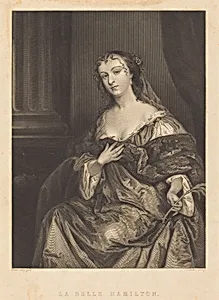
La Belle Hamilton
1751 to 1775
Medium
engraving
Dimensions
sheet: 34.6 × 25.6 cm (13 5/8 × 10 1/16 in.)
Classification
Department
CG-E
Museum
National Gallery of Art, Washington, D.C.
Credit
Rosenwald Collection
Accession Number
1980.45.1769
Rights
Public Domain
Art Historical Context
This elegant engraving captures the likeness of Elizabeth Hamilton, Countess of Gramont, known in her day as “La Belle Hamilton.” Created between 1751 and 1775 by Charles Rolls after an original portrait by Sir Peter Lely, the print preserves the memory of one of the most celebrated beauties at the court of Charles II. Lely’s flattering style, with its luminous skin tones and flowing drapery, helped define the image of the Restoration-era “Windsor Beauties,” a series of portraits that blended aristocratic glamour with subtle political meaning. As an engraving, the work demonstrates the important role reproductive prints played in the eighteenth century. By translating Lely’s oil painting into a more affordable medium, Rolls made this iconic image available to a wider audience, allowing viewers far from London to admire the celebrated court beauty. The crisp lines and careful modeling typical of the medium convey both the texture of fabric and the sitter’s poised expression, inviting modern visitors to appreciate how prints once carried royal and aristocratic imagery across time and distance. Housed in the National Gallery of Art’s Rosenwald Collection, the sheet measures just over 13 by 10 inches, a size well suited for private study or modest display. Today it offers a window onto both seventeenth-century court culture and the eighteenth-century fascination with earlier masters.