
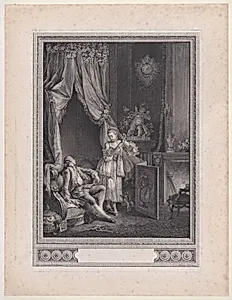
La Carquois Épuisé (The Empty Quiver)
Medium
Etching
Dimensions
image: 13 5/8 x 9 11/16 in. (34.6 x 24.6 cm) plate: 14 1/16 x 9 15/16 in. (35.7 x 25.2 cm) sheet: 16 15/16 x 13 in. (43 x 33 cm)
Classification
Prints
Department
Drawings and Prints
Museum
Metropolitan Museum of Art, New York, NY
Credit
Harris Brisbane Dick Fund, 1954
Accession Number
54.533.23
Rights
Public Domain
Tags
Art Historical Context
**La Carquois Épuisé (The Empty Quiver)**, created in 1775, is a charming etching by French artists Pierre Antoine Baudouin and Nicolas de Launay. Measuring 13⅝ × 9¹¹⁄₁₆ inches on the image, this print captures an intimate interior scene featuring men, women, and dogs—a playful tableau evocative of 18th-century French domestic life. The evocative title suggests Cupid's quiver run dry, hinting at themes of love, exhaustion, or amorous escapades in the waning Rococo era, just before the French Revolution. Etching, the medium here, allowed Launay's skilled burin to translate Baudouin's designs with delicate lines and tonal depth, making fine art accessible through reproductive prints. Popular in Enlightenment-era Paris, such works bridged painting and printmaking, democratizing elegant interiors for collectors. Acquired via the Harris Brisbane Dick Fund in 1954, this piece from the Metropolitan Museum of Art's Drawings and Prints department exemplifies the period's wit and refinement, inviting visitors to ponder the quiver's symbolic depletion amid lively human (and canine) companionship.
About the Artist
Pierre Antoine Baudouin|Nicolas de Launay · 1723–1769
Comment on works: Genre; History; Allegory