
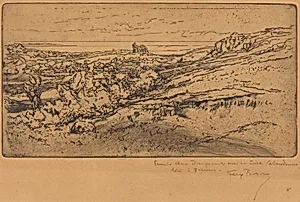
La Chapelle Saint-Michel à l'Estre (Second Version)
1826 to 1850
Medium
etching and drypoint on antique laid paper, soaked in turpentine
Dimensions
plate: 14 x 26.7 cm (5 1/2 x 10 1/2 in.) sheet: 21.4 x 36.8 cm (8 7/16 x 14 1/2 in.)
Classification
Department
CG-E
Museum
National Gallery of Art, Washington, D.C.
Credit
Gift of Daniel Bell and Pearl K. Bell
Accession Number
2006.68.31
Rights
Public Domain
Art Historical Context
Félix-Hilaire Buhot's *La Chapelle Saint-Michel l'Estre (Second)* captures the quaint charm of a rural French chapel, likely nestled in the Normandy countryside near Le Havre, where Buhot often drew inspiration. Created between 1826 and 1850— Buhot flourished in the later 19th century—this etching reflects the Romantic fascination with medieval architecture and atmospheric landscapes. As a master of intimate printmaking, Buhot evokes a sense of serene antiquity, inviting viewers to ponder the chapel's timeless spiritual presence amid its pastoral setting. Buhot's technical brilliance shines in his use of etching and drypoint on antique laid paper, soaked in turpentine to achieve velvety, painterly textures that blur lines and soften tones. This innovative "turpentine manner" mimics oil painting's fluidity, a hallmark of Buhot's experimental style during France's etching revival. The second version suggests meticulous refinement across states, enhancing depth and mood—drypoint's burr adding rich, tactile darkness to the stone facade. Housed in the National Gallery of Art thanks to the generous gift of Daniel Bell and Pearl K. Bell, this 14 x 26.7 cm plate exemplifies Buhot's legacy as a bridge between traditional engraving and modern impressionism, offering visitors a window into 19th-century France's artistic ingenuity.
About the Artist
Félix-Hilaire Buhot · 1847–1898
Félix-Hilaire Buhot was born on July 9, 1847, in Valognes, a small town in Normandy, France, into a modest family—his father a wine merchant and his mother a seller of women's clothes. Orphaned by age seven after losing both parents and his maternal grandmother, he was raised by relatives, including a godfather, and received an early introduction to drawing from his adopted mother's nephew. In 186...