
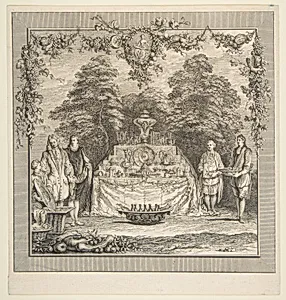
La Colation preparee dans un jardin
Medium
Etching, second state
Dimensions
sheet: 8 x 7 15/16 in. (20.3 x 20.2 cm) image: 7 1/4 x 7 5/16 in. (18.4 x 18.5 cm)
Classification
Prints
Department
Drawings and Prints
Museum
Metropolitan Museum of Art, New York, NY
Credit
The Elisha Whittelsey Collection, The Elisha Whittelsey Fund, 1968
Accession Number
68.542.35
Rights
Public Domain
Tags
Art Historical Context
In the enchanting etching *La Colation préparée dans un jardin* (The Snack Prepared in a Garden Claude Gillot and Charles Nicolaschin I capture a moment of leisurely outdoor indulgence. Gillot, a pioneering French artist and teacher to Antoine Watteau, contributed his inventive designs rooted in the early Rococo spirit—playful scenes blending theater, nature, and everyday revelry. Cochin I, a skilled engraver, brought these to life through meticulous etching, creating a collaborative print that reflects the vibrant print culture of early 18th-century France. The composition, featuring men amid lush gardens preparing a simple repast, evokes the era's fascination with *fêtes galantes*—elegant pastoral gatherings symbolizing refined pleasure. This second-state etching, measuring about 8 by 8 inches, highlights the medium's intimacy and reproducibility. Etching allowed artists like Gillot to sketch fluidly on a copper plate with acid biting the lines, producing delicate textures ideal for capturing foliage, fabrics, and expressions. As a print from the Metropolitan Museum of Art's Elisha Whittelsey Collection, it exemplifies how such works democratized art, circulating sophisticated imagery among collectors and the bourgeoisie. Though undated, the piece nods to the cultural shift toward outdoor sociability in France's *jardins anglais* precursors, blending food, camaraderie, and nature in a timeless tableau of joy. A delightful window into pre-Revolutionary leisure!
About the Artist
Claude Gillot|Charles Nicolas Cochin I · 1673–1722
Artist known for his elegant designs done in the Rococo manner of Audran; also for his predilection for scenes from the 'comedia dell'arte.' Few paintings survive; his work is known mainly through drawings and etchings. Comment on works: Genre; History