
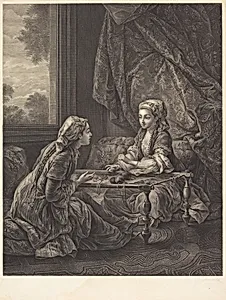
La Confidence
c. 1774/1775
Medium
engraving
Dimensions
sheet (trimmed to plate mark): 48.6 x 36.8 cm (19 1/8 x 14 1/2 in.)
Classification
Department
CG-E
Museum
National Gallery of Art, Washington, D.C.
Credit
Ailsa Mellon Bruce Fund
Accession Number
1984.80.1
Rights
Public Domain
Art Historical Context
**La Confidence**, an exquisite engraving by Jacques-Fir Beauvarlet after a painting by Carle Van, dates to around 1774–1775. Carle Van Loo, a French Rococo artist (1705–1765), was renowned for his elegant, playful scenes capturing the refined frivolity of 18th-century aristocratic life. This work, translating to "The Secret" or "The Confidence," likely depicts an intimate moment of whispered gossip between women, embodying the Rococo emphasis on delicate emotions, soft curves, and lighthearted sensuality. Beauvarlet, a skilled engraver, faithfully reproduced Van Loo's original in intricate detail, preserving its charm for a wider audience long after the painter's death. Engraving, the medium here, was a pinnacle of printmaking technique in the Enlightenment era. Using a burin to incise fine lines into a copper plate, Beauvarlet achieved tonal depth and texture that mimicked painting's luminosity—note the sheet trimmed to the plate mark at 48.6 x 36.8 cm. Prints like this democratized art, allowing collectors beyond the elite to own reproductions of masterpieces, bridging the gap between original oil paintings and public appreciation. Acquired through the Ailsa Mellon Bruce Fund for the National Gallery of Art's collection (Department CG-E), *La Confidence* highlights the cultural shift from opulent Versailles excess toward more intimate domesticity. It's a window into pre-Revolutionary France, where such vignettes reflected social graces and fleeting joys amid brewing change. Visitors, imagine the hushed thrill of shared secrets in powdered wigs and silk gowns!