
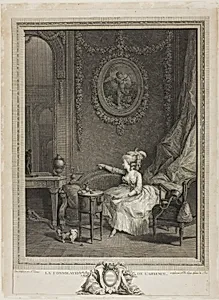
La Consolation de l'Absence (The consolation of absence)
1785
Medium
Engraving and etching on ivory laid paper
Dimensions
Image: 29 × 21.8 cm (11 7/16 × 8 5/8 in.); Sheet: 37.7 × 27.7 cm (14 7/8 × 10 15/16 in.)
Classification
etching
Department
Prints and Drawings
Museum
Art Institute of Chicago
Accession Number
30212
Rights
Public Domain
Art Historical Context
Created in 1785 by French engraver Nicolas Delaunay, *La Consolation de l'Absence* captures the sentimental spirit of late eighteenth-century France. The title, translating to “The Consolation of Absence,” hints themes of longing and memory that resonated during the Enlightenment, when personal emotion and intimate narratives gained favor in art. As a print rather than a painting, the work was designed for wider circulation, allowing viewers beyond aristocratic circles to engage with its evocative subject. Delaunay employed a combination of engraving and etching on ivory laid paper, techniques prized for their ability to render delicate lines and subtle tonal gradations. These methods enabled fine detail in textures—such as fabric folds or expressive faces—while the choice of paper lent a soft, luminous quality to the image. Measuring roughly 29 by 22 centimeters, the print exemplifies how reproductive media democratized art in the decades before the French Revolution. Today housed in the Art Institute of Chicago’s Department of Prints and Drawings, the sheet stands as a refined example of French eighteenth-century printmaking, bridging painting and popular visual culture. Its careful craftsmanship invites modern viewers to appreciate both the technical mastery and the tender human story it preserves.