
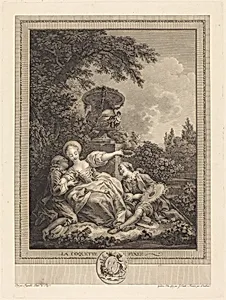
La coquette fixee
Medium
etching and engraving
Classification
Department
CG-E
Museum
National Gallery of Art, Washington, D.C.
Credit
Widener Collection
Accession Number
1942.9.2311
Rights
Public Domain
Art Historical Context
**La Coquette Fixée** is a delightful 18th-century print created by engravers Jacques Couché and Jean Dam after an original composition by the renowned French Rococo artist Jean-Honoré Frard. Produced between 1726 and 1750, this etching and engraving captures the playful essence of Fragonard's style, known for its lighthearted, sensual scenes of courtship and flirtation. The title, translating to "The Gazing Coquette," evokes a charming young woman lost in admiration or intrigue, embodying the Rococo era's celebration of love, elegance, and whimsy amid the opulent courts of pre-Revolutionary France. As a reproductive print from the Widener Collection at the National Gallery of Art (Department CG-E), it highlights the technical mastery of etching—using acid to bite lines into a metal plate—and engraving, where tools carve fine details for rich tonal effects. These methods allowed Fragonard's vibrant originals, often in oil or gouache, to reach wider audiences through affordable multiples, democratizing high art during the Enlightenment. This work reflects Rococo's cultural shift toward intimate, decorative pleasures over Baroque grandeur, offering visitors a window into 18th-century French social life. Gaze upon her coy expression and imagine the whispers of a Parisian salon—timeless allure in black and white!