
La Foire de Village
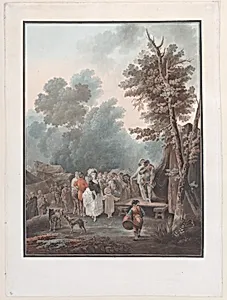
Medium
Color aquatint, etching, and engraving; proof
Dimensions
Image: 12 3/16 × 9 5/16 in. (31 × 23.6 cm) Sheet: 15 3/16 × 11 1/4 in. (38.6 × 28.5 cm)
Classification
Prints
Department
Drawings and Prints
Museum
Metropolitan Museum of Art, New York, NY
Credit
The Elisha Whittelsey Collection, The Elisha Whittelsey Fund, 1964
Accession Number
64.550.3
Rights
Public Domain
Art Historical Context
**La Foire de (The Village Fair)**, created between 1788 and 1794 by Charles Melchior Descis and Nicolas Antoine Ta, captures the bustling energy of a rural French fair. This proof print depicts everyday revelry—vendors, entertainers, and villagers mingling amid stalls and games—offering a vivid snapshot of pre-Revolutionary life in the French countryside. Descourtis, a mastermaker, collaborated with Taunay, known for his neoclassical landscapes, to evoke the charm and chaos of communal gatherings that were central to 18th-century social culture. The artwork's medium—a color aquatint combined with etching and engraving—marks a technical triumph. Aquatint, popularized in the late 1700s, allowed for rich tonal gradations and painterly effects, while the addition of color made it one of the era's innovative "painter-prints." As a proof, this impression reveals the artists' experimental process, with its subtle hues and intricate details heightening the scene's lively atmosphere on a modest scale (image: 12 3/16 × 9 5/16 in.). Housed in The Metropolitan Museum of Art's Drawings and Prints department, thanks to The Elisha Whittelsey Collection, *La Foire de Village* highlights printmaking's role in democratizing art. It bridged elite painting traditions with accessible imagery, preserving fleeting moments of joy amid France's turbulent revolutionary years. A delightful window into pastoral traditions! (198 words)