
La France
1904
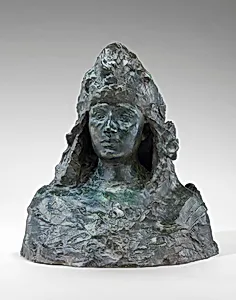
Medium
bronze
Dimensions
overall: 49.5 x 48.5 x 35.3 cm (19 1/2 x 19 1/8 x 13 7/8 in.)
Classification
Sculpture
Department
CSD
Museum
National Gallery of Art, Washington, D.C.
Credit
Gift of Mrs. John W. Simpson
Accession Number
1942.5.9
Rights
Public Domain
Art Historical Context
Auguste Rodin's *La France* (1904) is a compelling bronze sculpture that captures the sculptor's mastery of form and emotion during his mature period. Standing at nearly 50 cm tall, this intimate yet powerful work depicts an allegorical figure embodying the spirit of France, rendered with Rodin's signature textured surfaces—marked by the artist's own fingerprints for a lifelike, pulsating vitality. Created at a time when Rodin was at the height of his fame, following iconic pieces like *The Thinker* and *The Gates of Hell*, it reflects his innovative break from rigid academic traditions toward a more impressionistic, expressive style. Cast in bronze, the medium allowed Rodin to explore light and shadow through its rich patina and malleable modeling, techniques that revolutionized modern sculpture. Bronze's durability ensured the work's longevity, with multiple casts often produced from original plasters—a practice that broadened Rodin's influence. Gifted to the National Gallery of Art by Mrs. John W. Simpson, *La France* now resides in the museum's sculpture department, inviting visitors to ponder national identity through Rodin's humanistic lens. This piece not only showcases Rodin's technical brilliance but also evokes the cultural pride of early 20th-century France, making it a poignant highlight for any virtual tour.
About the Artist
Auguste Rodin · 1840–1917
François Auguste René Rodin (1840-1917) stands as the founder of modern sculpture, transforming the art form from academic tradition into expressive modernism. Born into a working-class Parisian family, Rodin faced early rejection, failing three times to gain admission to the prestigious École des Beaux-Arts. This setback forced him to work as a craftsman for nearly two decades, though his 1875 tr...