
La Mère Gérard
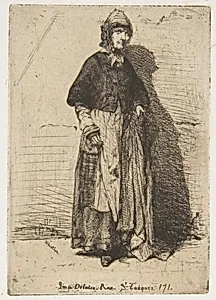
Medium
Etching, printed in black ink on brownish-gray chine on off-white wove paper (chine collé); fourth state of four (Glasgow)
Dimensions
Plate: 5 × 3 9/16 in. (12.7 × 9 cm) Sheet: 17 1/16 × 11 15/16 in. (43.3 × 30.4 cm)
Classification
Prints
Department
Drawings and Prints
Museum
Metropolitan Museum of Art, New York, NY
Credit
Harris Brisbane Dick Fund, 1917
Accession Number
17.3.5
Rights
Public Domain
Tags
Art Historical Context
James McNeill Whistler’sLa Mère Gérard*1858) is a poignant etching from the artist’s early career, capturing quiet dignity of an everyday woman—likely a maternal figure, as suggested by the title. Created during Whistler’s formative years in Paris, where he immersed himself in French realist influences, this intimate portrait reflects his fascination with urban life and ordinary people. At just 5 by 3 9/16 inches, the plate size invites close viewing, drawing visitors into the subtle textures of her face and attire. Printed in black ink on brownish-gray chine collé—a technique gluing delicate Oriental paper to sturdy off-white wove support for enhanced detail and richness—this work is the fourth and final state from the Glasgow catalog. Whistler’s etching prowess shines here, with fine lines evoking the precision of masters like Rembrandt while hinting at his emerging aesthetic sensitivity. Part of his "French Set," it showcases his innovative printmaking before his fame for tonal harmonies and Nocturnes. Housed in The Metropolitan Museum of Art’s Drawings and Prints department (Harris Brisbane Dick Fund, 1917), *La Mère Gérard* exemplifies 19th-century etching’s accessibility, bridging fine art and everyday observation. A testament to Whistler’s versatility, it reminds us how small-scale works can evoke profound humanity.
About the Artist
James McNeill Whistler · 1834–1903
James Abbott McNeill Whistler (1834-1903) was an American-born painter and printmaker who became a leading figure in the Aesthetic Movement and pioneer of Tonalism and Japonisme. He revolutionized art by championing "art for art's sake" and treating paintings as visual equivalents of musical compositions, titling works as "arrangements," "harmonies," and "nocturnes" to emphasize formal qualities o...