
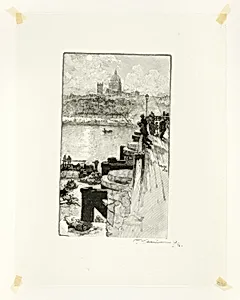
La Montagne Sainte-Geneviève, rue de l'Estacade, plate four from Le Long de la Seine et des Boulevards
1890, published 1910
Medium
Wood engraving in black on cream Japanese tissue
Dimensions
Image: 20.1 × 11.9 cm (7 15/16 × 4 11/16 in.); Sheet: 30 × 23.2 cm (11 13/16 × 9 3/16 in.)
Classification
wood engraving
Department
Prints and Drawings
Museum
Art Institute of Chicago
Accession Number
128526
Rights
Public Domain
Art Historical Context
In the heart of Paris's Left Bank, Louis Auguste Lepère's *La Montagne Sainte-Gviève, rue de l'Estacade* captures quiet moment along the Seine in 1890, as plate four from his series *Le Long de Seine et des Boulev*. Published in 1910, this wood showcases Lepère's mastery of a medium revived in late 19th-century France, where artists elevated woodcuts from mere illustration to fine art. Printed in black ink on delicate cream Japanese tissue—a thin, luxurious paper imported during the Japonisme craze—this intimate image (20.1 × 11.9 cm) evokes the bustling yet poetic streets reshaped by Baron Haussmann's urban renovations. Lepère, a leading figure in French printmaking, rendered the hill of Sainte-Geneviève—crowned by the Panthéon—with meticulous detail, using fine wood engraving lines to mimic the flickering light and textures of everyday Parisian life. The technique allowed for exceptional precision, blending realism with atmospheric depth, much like his Impressionist contemporaries but through the enduring clarity of black-and-white prints. Housed in the Art Institute of Chicago's Prints and Drawings department, this work reflects the era's fascination with capturing vanishing urban vignettes amid rapid modernization. Visitors will appreciate how Lepère's engraving preserves a slice of Belle Époque Paris, inviting us to linger on the rue de l'Estacade's humble charm—a testament to wood engraving's role in democratizing art for collectors and connoisseurs alike.
About the Artist
Louis Auguste Lepère · 1849–1918
Louis-Auguste Lepère (1849–1918) was born in Paris on November 30 to the sculptor François Lepère, immersing him early in the artistic world. At age thirteen, he apprenticed in the studio of the English wood engraver Joseph Burn-Smeeton, training there from 1862 to 1867, and later attended drawing courses under Horace Lecoq de Boisbaudran at the Petite École (now École nationale supérieure des art...