
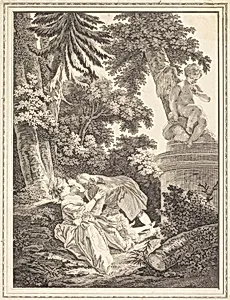
La nuit
Medium
etching and engraving
Classification
Department
CG-E
Museum
National Gallery of Art, Washington, D.C.
Credit
Widener Collection
Accession Number
1942.9.2514
Rights
Public Domain
Art Historical Context
**La Nuit** (*The Night*), an exquisite etching and engraving from around 1726–1750, was crafted by Emmanuel Jean Nepomucène de Ghendt after a design by the Rococo painter Pierre-Antoine Baudouin. Housed in the National Gallery Art's Widener Collection this print captures the playful elegance of 18th-century French art. Baudouin, a master of decorative and often sensual scenes, likely depicted Night as an allegorical figure—perhaps a graceful woman evoking mystery and repose amid soft shadows and swirling drapery, hallmarks of the Rococo style's ornate whimsy. Printmaking techniques like etching (using acid for fluid lines) and engraving (precise incisions for rich detail) allowed Ghendt to faithfully reproduce Baudouin's original painting, making high art accessible to a wider audience beyond elite collectors. During the Enlightenment era, such prints proliferated in salons and homes, disseminating Rococo's lighthearted motifs inspired by mythology and daily life. This work exemplifies how reproductive prints fueled artistic exchange in pre-Revolutionary France, blending technical virtuosity with cultural allure. Visitors, imagine the candlelit glow it once brought to aristocratic evenings—a timeless whisper of nocturnal enchantment.