
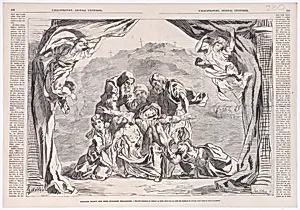
La Pietà, from "L'Illustration"
August 29, 1863
Medium
Wood engraving
Dimensions
Sheet: 14 3/16 × 20 7/16 in. (36.1 × 51.9 cm)
Classification
Prints
Department
Drawings and Prints
Museum
Metropolitan Museum of Art, New York, NY
Credit
Gift of Donato Esposito, 2019
Accession Number
2019.279.3
Rights
Public Domain
Art Historical Context
Welcome to the Metropolitan Museum of's Drawings and Prints department, where showcase *La Pietà* (August 29, 1863), a striking wood engraving from the renowned French periodical *L'Illustration*. Created by Romantic master Eugène Delacroix, with masterful translation into print by engraver Alexandre Pothey, this work depicts the timeless Christian motif of the Pietà—Mary cradling the lifeless body of Christ. Measuring 14 3/16 × 20 7/16 inches, it exemplifies 19th-century reproductive printmaking, generously gifted by Donato Esposito in 2019. Delacroix, a pioneer of Romanticism, infused his compositions with dramatic emotion, rich color (here evoked through tonal contrasts in black and white), and dynamic movement, hallmarks of his style seen in major paintings like *Liberty Leading the People*. Wood engraving, a precise technique where fine lines are incised into end-grain wood blocks for sharp, detailed reproduction, allowed such high-art imagery to reach a wide audience via affordable magazines like *L'Illustration*, a weekly chronicle of news, culture, and art from 1843 onward. This print not only honors the solemn pathos of the Pietà theme—central to Western art from Michelangelo onward—but also highlights the era's media revolution, democratizing Delacroix's genius just months before his death in 1863. A poignant bridge between fine art and popular culture!
About the Artist
Eugène Delacroix|Alexandre Pothey · 1798–1863
Eugène Delacroix (1798–1863) stands as the defining figure of French Romanticism and a pivotal bridge to modernism. Born in Charenton-Saint-Maurice near Paris, he came from distinguished lineage—his mother descended from the prestigious Oeben-Riesener furniture dynasty, while persistent speculation suggested the statesman Talleyrand may have been his biological father, a theory supported by physic...