
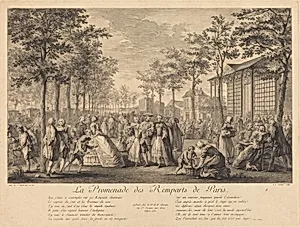
La promenade des remparts de Paris
Medium
etching and engraving
Dimensions
sheet: 33.3 × 41.5 cm (13 1/8 × 16 5/16 in.)
Classification
Department
CG-E
Museum
National Gallery of Art, Washington, D.C.
Credit
Widener Collection
Accession Number
1942.9.2179
Rights
Public Domain
Art Historical Context
Step into the elegant world of 18th-century Paris with *La promenade des remparts de Paris an enchanting etching and engraving created in 1760 by Pierre-Franc Courtois after the designs of Augustin de Saintubin. This print captures lively scene of fashionable Parisians strolling along the ramparts, a popular leisure spot where the elite and bourgeoisie mingled amid the grandeur of Louis XV's France. Measuring 33.3 × 41.5 cm, it offers intimate window into Rococo-era society, with its playful depiction of refined attire, social interactions, and urban charm. Saint-Aubin, a master engraver known for his intricate illustrations of French daily life, provided the original composition, which Courtois faithfully reproduced using the meticulous techniques of etching—for fluid, expressive lines—and engraving—for precise detailing. Prints like this were revolutionary in their time, making high art accessible beyond oil paintings by allowing multiple impressions for collectors and the public. Produced during a golden age of printmaking, it reflects the cultural fascination with *promenades* as stages for display and flirtation. Housed in the National Gallery of Art's Widener Collection (Department CG-E), this work invites us to ponder the vibrancy of pre-Revolutionary Paris, where rampart walks symbolized leisure and modernity. A delightful snapshot of history, it reminds us how art preserves the fleeting moments of joy.