
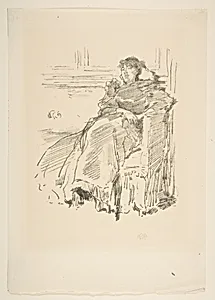
La Robe Rouge
Medium
Transfer lithograph; first state of two (Chicago); printed in black ink on medium weight laid cream laid paper
Dimensions
Image: 7 3/8 × 6 1/8 in. (18.8 × 15.5 cm) Sheet: 11 7/8 × 8 5/16 in. (30.1 × 21.1 cm)
Classification
Prints
Department
Drawings and Prints
Museum
Metropolitan Museum of Art, New York, NY
Credit
Harris Brisbane Dick Fund, 1917
Accession Number
17.3.212
Rights
Public Domain
Tags
Art Historical Context
**La Robe Rouge** (The Red Dress), created by James McNeill Whistler in1894, captures the elegant poise of a woman in a striking gown through the delicate medium of transfer lithography. This first-state impression from the Chicago edition, printed in black ink on laid paper, measures a intimate 7 3/8 × 6 1/8 inches. Whistler, the American-born artist renowned for his Aestheticism and subtle tonal harmonies—think *Whistler's Mother*—excelled in printmaking, producing over 500 lithographs that distilled his philosophy of "art for art's sake." Transfer lithography, Whistler's favored technique here, involved drawing on paper that was then transferred to a lithographic stone, yielding fluid, painterly lines with remarkable subtlety. This print exemplifies his late-career mastery, where everyday subjects like fashion become exercises in composition and mood, influenced by Japanese prints and Impressionist lightness. The "first state" rarity adds to its allure, showcasing the artwork before later refinements. Housed in the Metropolitan Museum of Art's Prints department (Harris Brisbane Dick Fund, 1917), *La Robe Rouge* reflects fin-de-siècle fascination with feminine grace amid Europe's artistic ferment. A gem for print enthusiasts, it invites viewers to savor Whistler's quiet revolution in beauty and balance.
About the Artist
James McNeill Whistler · 1834–1903
James Abbott McNeill Whistler (1834-1903) was an American-born painter and printmaker who became a leading figure in the Aesthetic Movement and pioneer of Tonalism and Japonisme. He revolutionized art by championing "art for art's sake" and treating paintings as visual equivalents of musical compositions, titling works as "arrangements," "harmonies," and "nocturnes" to emphasize formal qualities o...