
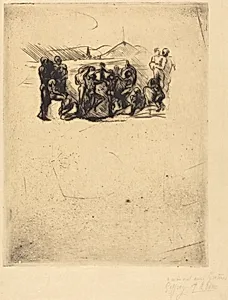
La Ronde
probably 1883
Medium
drypoint
Classification
Department
CG-E
Museum
National Gallery of Art, Washington, D.C.
Credit
Rosenwald Collection
Accession Number
1943.3.7402
Rights
Public Domain
Art Historical Context
**La Ronde** is a captivating drypoint print by Auguste Rodin, around 1883 and now housed in the National Gallery of's Rosenwald Collection. primarily as a master sculptor—famous for works like * Thinker* and * Gates of Hell*—Rod briefly explored printmaking during the 1880s, producing a small body of intimate etchings that reveal his extraordinary command of line and form. The title *La Ronde*, meaning "The Round Dance" in French, evokes swirling movement and communal rhythm, a motif echoing the dynamic energy of his sculptural figures. Drypoint, Rodin's chosen medium here, is an intaglio technique where the artist scratches directly into a metal plate with a sharp tool, raising a soft burr that produces rich, velvety lines in the print. Unlike more precise engraving, drypoint allows for spontaneous, expressive strokes, mirroring Rodin's sculptural approach of modeling clay with intense immediacy. These prints, often in tiny editions, were experimental diversions from his monumental bronzes, showcasing his versatility amid the late 19th-century Parisian art scene. This rare work highlights Rodin's fascination with the human body in motion, bridging his sculptural innovations with the graphic arts. For visitors, *La Ronde* offers a window into the artist's private studio practice, blending technical mastery with poetic grace. (198 words)
About the Artist
Auguste Rodin · 1840–1917
François Auguste René Rodin (1840-1917) stands as the founder of modern sculpture, transforming the art form from academic tradition into expressive modernism. Born into a working-class Parisian family, Rodin faced early rejection, failing three times to gain admission to the prestigious École des Beaux-Arts. This setback forced him to work as a craftsman for nearly two decades, though his 1875 tr...