
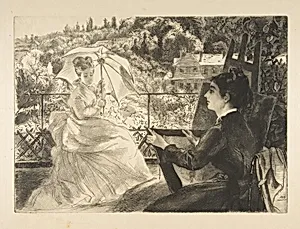
La Terrasse de la VIlla Brancas
Medium
Etching, drypoint; seventh state of eight
Dimensions
Sheet: 13 1/4 × 19 3/16 in. (33.7 × 48.8 cm) Plate: 9 15/16 × 13 7/8 in. (25.3 × 35.3 cm)
Classification
Prints
Department
Drawings and Prints
Museum
Metropolitan Museum of Art, New York, NY
Credit
Gift of David Keppel, 1922
Accession Number
22.1.20
Rights
Public Domain
Tags
Art Historical Context
Félix Bracquemond's *La Terrasse de la Villa Brancas* (1876) captures an elegant outdoor scene on the terrace of a luxurious villa, likely evoking the leisurely charm of 19th-century French high society. Rendered in etching and drypoint, this print features women in graceful poses amid architectural details and lush surroundings, blending precise linework with atmospheric depth. Bracquemond, a pivotal figure in France's etching revival during the 1860s–70s, drew inspiration from Japanese prints, infusing his works with intricate compositions and a sense of refined beauty. This impression represents the seventh state of eight, showcasing Bracquemond's meticulous process of refining the copper plate—adding burrs via drypoint for velvety textures and subtle tonal variations that mimic painting's richness. Etching allowed artists like him to produce original, painterly prints affordable to collectors, bridging fine art and reproduction in an era dominated by lithography. A gift to the Metropolitan Museum of Art from David Keppel in 1922, this work highlights Bracquemond's mastery in the print medium, offering visitors a window into Second Empire elegance and the technical innovation of graphic arts. (198 words)
About the Artist
Félix Bracquemond · 1833–1914
French, Paris 1833–1914 Sèvres