
La Toilette
1927
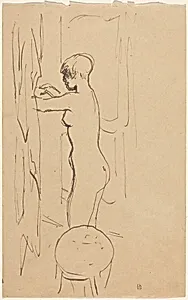
Medium
brown pen and ink on beige wove paper
Dimensions
overall: 21 x 13.2 cm (8 1/4 x 5 3/16 in.)
Classification
Drawing
Department
CG-E
Museum
National Gallery of Art, Washington, D.C.
Credit
Virginia and Ira Jackson Collection
Accession Number
2005.157.3
Rights
Public Domain
Art Historical Context
Pierre Bonnard's *La Toilette* (1927) invites visitors into the intimate world of everyday rituals, captured in a delicate brown pen and ink drawing on beige wove paper. Measuring just 21 x 13.2 cm, this modest-scale work exemplifies Bonnard's fascination with domestic scenes, likely depicting a woman at her morning toilette—a motif he revisited throughout his career, often featuring his wife, Marthe, as his muse. Housed in the National Gallery of Art's Virginia and Ira Jackson Collection, it showcases the artist's precise line work in a portable, sketch-like format. As a key figure in Post-Impressionism and the Nabi group, Bonnard was renowned for his vibrant paintings that blurred indoor and outdoor spaces with luminous color. This drawing, however, highlights his masterful draughtsmanship, using fluid pen strokes to suggest form, texture, and subtle movement without relying on paint. Created in the interwar years, it reflects Bonnard's enduring interest in the beauty of the mundane, bridging his early symbolist influences with his mature style. For museum-goers, *La Toilette* offers a rare glimpse into Bonnard's preparatory process, revealing how his keen observation of light and shadow informed his larger oils. Its intimate scale encourages close viewing, drawing us into a private moment frozen in time.
About the Artist
Pierre Bonnard · 1867–1947
Pierre Bonnard (1867–1947) was a French painter and printmaker who became a leading figure in the Post-Impressionist movement and a founding member of Les Nabis. Born on October 3, 1867, in Fontenay-aux-Roses, France, Bonnard initially studied law at his father's insistence, graduating and briefly practicing as a barrister in 1888. However, his true passion lay in art, and he had simultaneously at...