
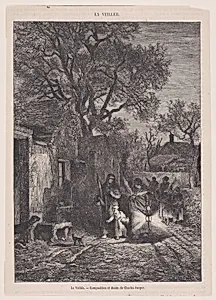
La Veillée; from Magasin Pittoresque
ca. 1852
Medium
Wood engraving
Dimensions
Sheet (Trimmed): 8 1/4 × 6 5/8 in. (21 × 16.8 cm) Image: 8 5/16 × 6 1/8 in. (21.1 × 15.6 cm)
Classification
Prints
Department
Drawings and Prints
Museum
Metropolitan Museum of Art, New York, NY
Credit
Harris Brisbane Dick Fund, 1933
Accession Number
32.36.31
Rights
Public Domain
Art Historical Context
"La Veillée," a wood engraving created around 1852 by Charles Jacque in collaboration with François Rouget, captures a quiet moment of rural French life. Published in the popular illustrated magazine *Magasin Pitque*, the print exemplifies the era’s growing interest in accessible imagery for a broad audience. Jacque, associated with the Barbizon School, often depicted peasant scenes and natural settings, bringing an intimate realism to everyday subjects. Wood engraving was a vital 19th-century technique prized for its ability to produce fine, durable lines that could be printed alongside text in periodicals. This medium helped democratize art, allowing viewers far from galleries to engage with contemporary themes. The trimmed sheet, measuring just over eight inches tall, reflects the modest yet impactful scale typical of magazine illustrations. Acquired by the Metropolitan Museum of Art through the Harris Brisbane Dick Fund in 1933, the work preserves a snapshot of mid-century French visual culture. It highlights how printmaking bridged fine art and popular media during a period of rapid social change.
About the Artist
Charles Jacque|François Rouget · 1813–1894
Charles-Émile Jacque (1813–1894) was a pioneering French painter, engraver, and illustrator whose career bridged the worlds of printmaking and pastoral painting. Born in Paris amid a difficult childhood, he apprenticed at age seventeen to a map engraver, mastering drypoint technique and producing his first etching in 1830—a copy of a head after Rembrandt. After serving seven years in the French Ar...