
La Vieille aux Loques
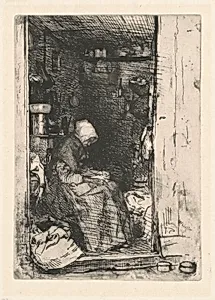
Medium
etching and drypoint in black on laid paper
Dimensions
image: 8 1/4 x 5 7/8 in. (20.96 x 14.92 cm) sheet: 10 1/2 x 7 5/8 in. (26.67 x 19.37 cm)
Classification
Department
CG-W
Museum
National Gallery of Art, Washington, D.C.
Credit
Corcoran Collection (Bequest of Julius Garfinckel)
Accession Number
2015.19.417
Rights
Public Domain
Art Historical Context
**La Vieille aux Lo (The Old Rag Woman)** James McNeill Whistler 1858 Created in 1858 during Whistler's formative years in Paris, * Vieille aux Loques* captures a humble Parisian rag seller with unflinching realism. This and drypoint on laid paper—measuring just 8¼ × 5⅞ inches—exemplifies Whistler's early fascination with urban poverty, influenced by French Realists like Gustave Courbet. At age 24, fresh from his military academy days, Whistler immersed himself in the city's bohemian art scene, producing a series of etchings that elevated everyday subjects to poetic dignity. Whistler's masterful use of etching (acid-etched lines for precision) combined with drypoint (a needle-scratched burr for velvety textures) creates subtle tonal depths and atmospheric haze, hallmarks of his innovative printmaking. These techniques allowed for rich, painterly effects rare in prints at the time, foreshadowing his later Aestheticism and nocturnes. Part of the Corcoran Collection at the National Gallery of Art, this work highlights Whistler's precocious talent and enduring influence on modern printmakers. A poignant snapshot of 19th-century street life, it invites viewers to appreciate the beauty in the overlooked, blending social observation with technical brilliance. (198 words)
About the Artist
James McNeill Whistler · 1834–1903
James Abbott McNeill Whistler (1834-1903) was an American-born painter and printmaker who became a leading figure in the Aesthetic Movement and pioneer of Tonalism and Japonisme. He revolutionized art by championing "art for art's sake" and treating paintings as visual equivalents of musical compositions, titling works as "arrangements," "harmonies," and "nocturnes" to emphasize formal qualities o...