
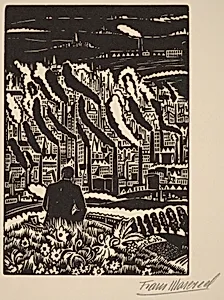
La Ville
1925
Medium
woodcut on wove paper
Dimensions
plate: 16.3 x 11.2 cm (6 7/16 x 4 7/16 in.) sheet: 24.2 x 18.6 cm (9 1/2 x 7 5/16 in.)
Classification
Department
CG-W
Museum
National Gallery of Art, Washington, D.C.
Credit
Gift of Elizabeth C. Lukacs
Accession Number
1994.35.13
Rights
Public Domain
Art Historical Context
Frans Masereel’s 1925 woodcut *La Ville* captures the dynamic energy of the modern city through bold, expressive lines carved into wood and printed on wove paper. As a Belgian artist working in the early twentieth century, Masereel was a master of the woodcut medium, which allowed him to create stark contrasts and rhythmic patterns that convey both the vitality and the tensions of urban life. This small yet powerful print, measuring just over six inches in height, exemplifies his ability to distill complex social scenes into a single, compelling image. Created during a period of rapid industrialization and social change following World War I, *La Ville* reflects the era’s fascination with the city as both a symbol of progress and a site of human struggle. Masereel often used the woodcut technique—rooted in centuries-old printmaking traditions but revived by modern artists—for its democratic potential, enabling wide distribution of his work. The print’s modest scale and crisp black-and-white design invite close looking, revealing layers of architectural forms and figures that pulse with movement. Now part of the National Gallery of Art’s collection through the generosity of Elizabeth C. Lukacs, *La Ville* stands as a fine example of Masereel’s influential contributions to twentieth-century graphic art. Its timeless portrayal of the urban experience continues to resonate with viewers today.