
Labourers
George Stubbs|Amos Greene|Richard Earlom|Robert Laurie|Benjamin Beale Evans, March 25, 1790
About this artwork
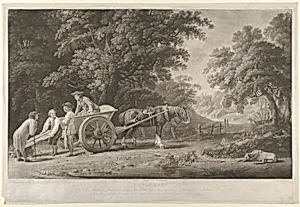
"Labourers," a captivating mezzotint print from 25, 1790, brings together the talents of British artist George Stubbs—renowned for his precise depictions of horses and anatomy—with engravers Amos Greene, Richard Earlom Robert Laurie, and Benjaminale Evans. This second state of four captures a bustling scene of working men tending to horses and carriages, evoking the rhythms of late 18th-century rural in Britain. Measuring a generous plate size of 17 3/8 x 25 7/8 inches, it exemplifies the print's role in democratizing art, allowing wider audiences to own reproductions of Stubbs' original compositions. Mezzotint, a technique perfected in 17th-century England, shines here through its velvety blacks and subtle gradations, ideal for conveying the textures of horsehair, leather harnesses, and weathered faces. Stubbs, a pioneer in equine portraiture tied to the Enlightenment's scientific curiosity, infused his works with anatomical accuracy, making this print not just a visual delight but a document of human-animal partnership during early industrialization. Housed in the Metropolitan Museum of Art's Drawings and Prints department (acquired via the Harris Brisbane Dick Fund in 1973), "Labourers" highlights printmaking's evolution across states—each refining details or adding publisher's marks. For visitors, it's a window into Georgian Britain's working world, where horses powered progress.