
Laburnums and Battersea
1889/90 and 1898
Medium
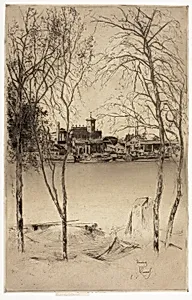
Etching and drypoint in black, with selective wiping of plate tone, on ivory laid paper
Dimensions
Image/plate: 34.2 × 22.1 cm (13 1/2 × 8 3/4 in.); Sheet, with signature tab: 34.4 × 21.9 cm (13 9/16 × 8 5/8 in.)
Classification
etching
Department
Prints and Drawings
Museum
Art Institute of Chicago
Accession Number
210940
Rights
Public Domain
About this artwork
For his early prints, Roussel adapted James McNeill Whistler’s methods to express his own interest in documenting the local scene, and Laburnums and Battersea is a striking example of the older artist’s influence. Roussel developed his plate through multiple states, used a variety of ink colors, and employed selective wiping to suggest differing effects of light, water, and mist. He also chose an upright format and a larger scale than his other prints depicting Chelsea and the Battersea factorie...
About the Artist
Theodore Roussel · 1847–1926
Theodore Casimir Roussel was born on 23 March 1847 in Lorient, Brittany, France, into a naval family. After serving in the Franco-Prussian War, he began painting in 1872 as an entirely self-taught artist, initially rendering scenes of daily life in the meticulous style of the Old Masters. In 1878, he settled permanently in London, where he immersed himself in the vibrant British art scene. There, ...