
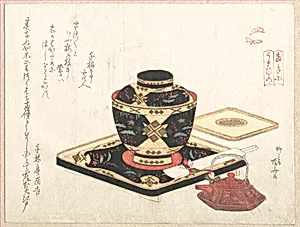
Lacquer Bowl for New Year Food
19th century
Medium
Woodblock print (surimono); ink and color on paper
Dimensions
5 5/8 x 7 7/16 in. (14.3 x 18.9 cm)
Classification
Prints
Culture & Period
Japan · Edo period (1615–1868)
Department
Asian Art
Museum
Metropolitan Museum of Art, New York, NY
Credit
H. O. Havemeyer Collection, Bequest of Mrs. H. O. Havemeyer, 1929
Accession Number
JP1998
Rights
Public Domain
Tags
Art Historical Context
Welcome to the Asian Art, where we encounter the exquisite "Lacquer Bowl for Year Food," a 19th-century wood print (surimono) by Ryūryūkyo Shinsai. Created during Japan's Edo period (16151868), this intimate work measures just 5⅝ × 7⅜ inches, showcasing Shinsai's mastery in the ukiyo-e tradition. Surim were privately commissioned prints, often produced for New Year's greetings or celebrations, blending artistry with poetry and lavish printing techniques like subtle embossing, mica dusting, and vibrant inks on paper. The print depicts a lacquer bowl brimming with festive New Year foods, evoking the joyous rituals of osechi or zoni traditions that symbolized renewal and prosperity in Edo-era Japan. Shinsai, a leading surimono specialist, captured the glossy sheen of lacquerware and the tactile allure of seasonal delicacies with remarkable precision, highlighting the cultural reverence for craftsmanship and communal feasting. Though tagged with teapots—perhaps nodding to related still-life motifs—this piece celebrates abundance and impermanence, core themes in Japanese aesthetics. Generously bequeathed through the H.O. Havemeyer Collection in 1929, it now graces the Metropolitan Museum of Art, inviting us to savor the refined elegance of everyday splendor transformed into art.
About the Artist
Ryūryūkyo Shinsai · 1799–1823
Ryūryūkyo Shinsai (柳々居辰斎), active from 1799 to 1823, was a prominent Japanese ukiyo-e printmaker based in Edo (modern Tokyo), renowned for his mastery of surimono—luxurious, privately commissioned woodblock prints produced for elite poetry circles and New Year's celebrations. He began his training under Tawaraya Sōri before becoming a student of the legendary Katsushika Hokusai, from whom he recei...