
Lady in an armchair
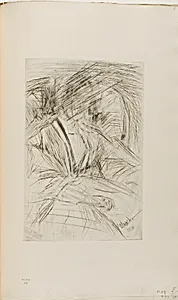
Medium
Drypoint, with drypoint and scraped cancellation, in black ink on ivory laid paper
Dimensions
Plate: 22.7 × 15.2 cm (8 15/16 × 6 in.); Sheet, sight, bound: 37.4 × 24 cm (14 3/4 × 9 1/2 in.)
Classification
drypoint
Department
Prints and Drawings
Museum
Art Institute of Chicago
Accession Number
190727
Rights
Public Domain
Art Historical Context
Step into the intimate world of James McNeillistler's *Lady in an Armchair (1861), a drypoint print that captures the quiet elegance of a seated woman. Created during Whistler's formative years in London, when he was pioneering innovative printmaking techniques amid the Etching Revival, this work exemplifies his shift toward subtle realism and atmospheric effects. The artist, an American expatriate renowned for his tonal harmonies and later Aestheticism, here renders the subject with a directness that echoes his portraits in oil. Whistler's drypoint process—scratching lines directly into a copper plate with a sharp tool—produces the signature "burr," a soft, velvety texture from raised metal edges that holds rich black ink on ivory laid paper. He enhanced this with scraped cancellation, a method to refine or limit editions by burnishing parts of the plate, adding to the print's rarity and tonal depth. Measuring just 22.7 × 15.2 cm on the plate, its modest scale invites close viewing, revealing the interplay of light and shadow on fabric and form. Housed in the Art Institute of Chicago's Prints and Drawings collection, *Lady in an Armchair* highlights Whistler's technical virtuosity and influence on modern printmaking. It offers a glimpse into Victorian domesticity, blending portraiture with experimental artistry that prioritized mood over narrative. A gem for print enthusiasts!
About the Artist
James McNeill Whistler · 1834–1903
James Abbott McNeill Whistler (1834-1903) was an American-born painter and printmaker who became a leading figure in the Aesthetic Movement and pioneer of Tonalism and Japonisme. He revolutionized art by championing "art for art's sake" and treating paintings as visual equivalents of musical compositions, titling works as "arrangements," "harmonies," and "nocturnes" to emphasize formal qualities o...