
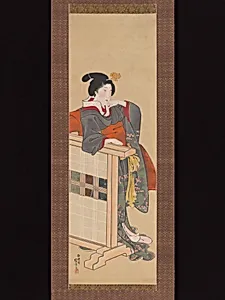
大奥女中芝居見物図|Lady-in-Waiting at Edo Castle
ca. 1854–60 (Ansei era)
Medium
Hanging scroll; ink and color on silk
Dimensions
Image: 35 7/8 × 11 1/2 in. (91.2 × 29.2 cm) Overall with mounting: 70 3/4 × 16 3/8 in. (179.7 × 41.6 cm) Overall with knobs: 70 3/4 × 18 1/2 in. (179.7 × 47 cm)
Classification
Paintings
Culture & Period
Japan · Edo period (1615–1868)
Department
Asian Art
Museum
Metropolitan Museum of Art, New York, NY
Credit
Gift of Sue Cassidy Clark, in honor of Barbara Brennan Ford, 2020
Accession Number
2020.75.3
Rights
Public Domain
Art Historical Context
In the opulent world of Edo-period Japan, Utagawaiyoshi captures a rare glimpse into the secluded lives of the shogun's with *Lady-in-Waiting Edo Castle* (ca. 1854–60). This hanging scroll, rendered in vibrant ink and color on silk depicts a female attendant from the Ō-oku—the women's quarters of Edo Castle—perhaps stealing a moment to enjoy kabuki theater (*shibai kenbutsu*). Kuniyoshi, a master the ukiyo-e tradition famed for his dynamic woodblock prints of warriors and mythical heroes, here applies his keen eye for everyday drama to elite female society, blending elegance with subtle intrigue. Created during the Ansei era (1854–60), a time of political tension as Japan faced Western pressures, the artwork reflects the insulated splendor of the Tokugawa shogunate's final decades. Hanging scrolls like this were prized for private display in homes or temples, their silk surfaces allowing rich pigments to shimmer under soft light, evoking the scroll's ritual unrolling for intimate viewing. Kuniyoshi's fluid lines and vivid palette highlight the lady's refined kimono and poised demeanor, offering visitors a window into forbidden Edo glamour. A gift to the Metropolitan Museum of Art, this piece celebrates Japan's artistic legacy of capturing fleeting beauty amid rigid hierarchies.
About the Artist
Utagawa Kuniyoshi 歌川國芳 (Japanese) · 1797 –1861
Japanese, 1797–1861