
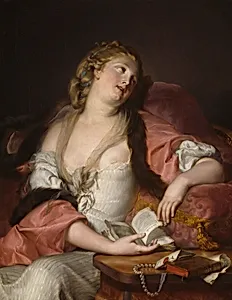
Lady Reading the Letters of Heloise and Abelard
c. 1780
Medium
Oil on canvas
Dimensions
81.3 × 64.8 cm (32 × 25 1/2 in.); Framed: 105.5 × 89.9 × 11.5 cm (41 1/2 × 35 3/8 × 4 1/2 in.)
Classification
oil on canvas
Department
Painting and Sculpture of Europe
Museum
Art Institute of Chicago
Accession Number
133859
Rights
Public Domain
About this artwork
This painting depicts a young woman lost in reverie after reading the letters of the ill-fated medieval lovers Heloise and Abelard. The objects on the table beside her—a letter, a sheet of music, and a book of erotic poetry—hint at a life of leisure and a susceptibility to love. In this early picture, Auguste Bernard drew upon history paintings by Peter Paul Rubens and Charles Le Brun, as well as Parisian traditions of genre painting and portraiture pioneered by Jean-Baptiste Greuze. Bernard wor...
Art Historical Context
This evocative oil on canvas by Bernard d'Agescy, painted around 1780, depicts a solitary woman absorbed in the famous letters exchanged between the medieval lovers Peter Abelard and Heloise. The composition invites viewers into a private moment of reflection, highlighting the timeless power of written words to stir emotion and imagination. Measuring just over 32 by 25 inches, the intimate scale encourages close looking, much as the figure herself leans into her reading. The subject draws on a story that fascinated audiences in the late eighteenth century. The tragic twelfth-century romance of the brilliant philosopher Abelard and his brilliant pupil Heloise had been rediscovered and widely published, resonating with Enlightenment interests in sentiment, education, and individual feeling. d'Agescy’s choice of oil on canvas allowed for the luminous rendering of fabrics, delicate lighting, and subtle facial expressions that heighten the scene’s quiet intensity. Today in the Art Institute of Chicago’s collection of European paintings, the work offers a window into how eighteenth-century viewers connected with the past through literature and art. It reminds us that the act of reading can be both deeply personal and profoundly connective across centuries.