
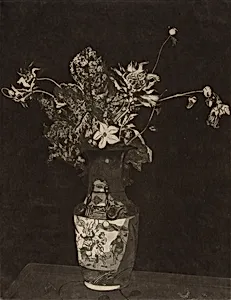
L'Agonie des Fleurs (Black and White Version)
1890–95
Medium
Etching, softground, and aquatint in black on cream wove imitation Japanese paper
Dimensions
Image: 44.5 × 34.6 cm (17 9/16 × 13 5/8 in.); Plate: 45.2 × 34.8 cm (17 13/16 × 13 3/4 in.); Sheet: 48.2 × 36.9 cm (19 × 14 9/16 in.)
Classification
etching
Department
Prints and Drawings
Museum
Art Institute of Chicago
Accession Number
210950
Rights
Public Domain
About this artwork
This still life is Roussel’s best-known print and represents the culmination of his experiments in combining soft ground and aquatint with line etching. The powerful effect of rich blacks, subtle grays, and sensitively placed brighter, unetched areas elevates the unpretentious subject matter—an arrangement of dying flowers in a vase of decorative stoneware, which was readily available for purchase in late 19th-century London.
Art Historical Context
In the late 19th century, artist Theodore Roussel crafted *L'Agonie des Fleurs (Black and White)* between 1890 and 1895, a poignant etching that captures the delicate decay of flowers in exquisite monochrome. Roussel, influenced by James McNeill Whistler and the Aesthetic movement, favored intimate, atmospheric prints that emphasized beauty and subtlety over narrative drama. This work, housed in the Art of Chicago's Prints and department, exemplifies his mastery of tonal nuance on cream wove imitation Japanese paper—a nod to Japonisme, the era's fascination with Eastern aesthetics. Roussel employed a sophisticated blend of etching for precise lines, softground for velvety textures mimicking pencil strokes, and aquatint for rich, graduated tones that evoke the wilting petals' fragile "agony." Measuring about 17½ by 13⅝ inches, the image invites close contemplation, its meticulous technique highlighting the printmaker's revival of these intaglio methods as fine art, rivaling painting in expressive depth. This black-and-white iteration underscores the universality of floral motifs in Symbolist circles, where flowers symbolized transience and beauty's fleeting nature. A gem for print enthusiasts, it reflects the period's shift toward decorative, sensory art, making it a captivating stop in any virtual gallery tour.
About the Artist
Theodore Roussel · 1847–1926
Theodore Casimir Roussel was born on 23 March 1847 in Lorient, Brittany, France, into a naval family. After serving in the Franco-Prussian War, he began painting in 1872 as an entirely self-taught artist, initially rendering scenes of daily life in the meticulous style of the Old Masters. In 1878, he settled permanently in London, where he immersed himself in the vibrant British art scene. There, ...