
Lagoon: Noon
1879/1880
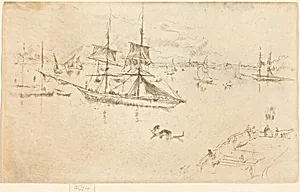
Medium
etching and drypoint in dark brown on laid paper
Dimensions
plate: 12.38 x 20.32 cm (4 7/8 x 8 in.) sheet (includes tab with signature): 13.34 x 20.32 cm (5 1/4 x 8 in.)
Classification
Department
CG-W
Museum
National Gallery of Art, Washington, D.C.
Credit
Rosenwald Collection
Accession Number
1943.3.8552
Rights
Public Domain
Art Historical Context
**Lagoon: Noon** (1879/1880) by James McNeill Whistler captures the shimmering tranquility of Venice's lagoon at midday, part of the artist's renowned Second Venice Set. Exiled in Venice after his infamous 1878 libel trial against critic John Ruskin—which bankrupted him but boosted his fame—Whistler produced around 50 etchings and pastels during a brief, productive stay. This intimate print, measuring just under 5 by 8 inches, reflects his Aesthetic movement philosophy: "art for art's sake," prioritizing subtle harmony over literal detail. Whistler's mastery shines in his etching and drypoint technique, executed in dark brown ink on laid paper. Etching creates precise lines through acid-biting the plate, while drypoint—scratched directly with a needle—produces a soft, velvety burr for tonal depth, evoking the lagoon's hazy light and gentle ripples. The signed tab on the sheet adds a personal touch, typical of his prints. Housed in the National Gallery of Art's Rosenwald Collection, *Lagoon: Noon* exemplifies Whistler's innovative printmaking, bridging painting and graphics. It invites viewers to savor atmospheric beauty, a timeless nod to Venice's enduring allure.
About the Artist
James McNeill Whistler · 1834–1903
James Abbott McNeill Whistler (1834-1903) was an American-born painter and printmaker who became a leading figure in the Aesthetic Movement and pioneer of Tonalism and Japonisme. He revolutionized art by championing "art for art's sake" and treating paintings as visual equivalents of musical compositions, titling works as "arrangements," "harmonies," and "nocturnes" to emphasize formal qualities o...