
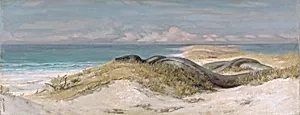
Lair of the Sea Serpent
Elihu Vedder, ca. 1899
About this artwork
Elihu Vedder's *Lair of the Sea Serpent* (ca. 1899), an evocative oil on canvas measuring 12 x 30 inches, transports viewers to a mystical beachscape haunted by serpentine creatures. This American artist's imaginative composition, housed in the Metropolitan Museum of Art's American Wing, blends rugged shorelines with mythical menace, inviting contemplation of nature's hidden dangers. Vedder (1836–1923), a key figure in late 19th-century American art, drew from Symbolism and the Aesthetic Movement, often infusing his works with dreamlike allegory and exotic mysticism. Having spent much of his career in Italy among expatriate artists, he explored themes of fantasy and the subconscious, as seen in his illustrations for Edward FitzGerald's *Rubaiyat*. The oil medium allows Vedder's luminous colors and fluid forms to evoke the sea's treacherous allure, a technique honed during the Gilded Age when American painters embraced European influences. This intimate landscape captures the era's fascination with myth and the sublime, reflecting broader cultural anxieties about the unknown. A gift to the Met in 1976, it exemplifies Vedder's enduring legacy in bridging realism and reverie for modern audiences.