
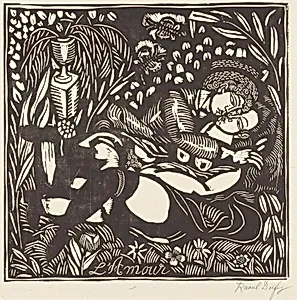
L'Amour
c. 1910
Medium
woodcut in black on Chinese paper
Dimensions
image: 31.12 × 31.43 cm (12 1/4 × 12 3/8 in.) sheet: 46.36 × 57.79 cm (18 1/4 × 22 3/4 in.)
Classification
Department
CG-W
Museum
National Gallery of Art, Washington, D.C.
Credit
Rosenwald Collection
Accession Number
1950.16.53
Rights
Public Domain
Art Historical Context
Raoul Dufy’s *L’Amour*, created around 1910, captures the artist’s early exploration of printmaking during a pivotal moment in modern art. A leading figure of the Fauvist movement,y was celebrated for his vibrant colors and fluid lines, yet this woodcut reveals his mastery of stark contrast and simplified form. Printed in black on delicate Chinese paper, the work highlights the tactile quality of the medium, where the grain of the wood block adds texture and spontaneity to the composition. Woodcuts enjoyed a revival in the early twentieth century as artists sought expressive, handcrafted alternatives to industrial reproduction. Dufy’s choice of this ancient technique allowed him to distill a scene of love into bold, graphic shapes that feel both intimate and universal. The generous margins of the sheet emphasize the print’s status as a fine-art object rather than a mere illustration. Housed in the National Gallery of Art’s Rosenwald Collection, *L’Amour* offers visitors a glimpse into Dufy’s versatility. It reminds us how printmaking bridged fine art and everyday life, inviting viewers to appreciate the quiet poetry of black ink on paper.
About the Artist
Raoul Dufy · 1877–1953
Raoul Dufy (1877–1953) was a French painter whose vivid, sunlit canvases became among the most recognizable expressions of joie de vivre in twentieth-century art. Born in Le Havre, he studied at the École des Beaux-Arts there before moving to Paris, where he enrolled at the École nationale supérieure des Beaux-Arts and fell under the influence of the Impressionists. An early encounter with Henri M...